

The problem
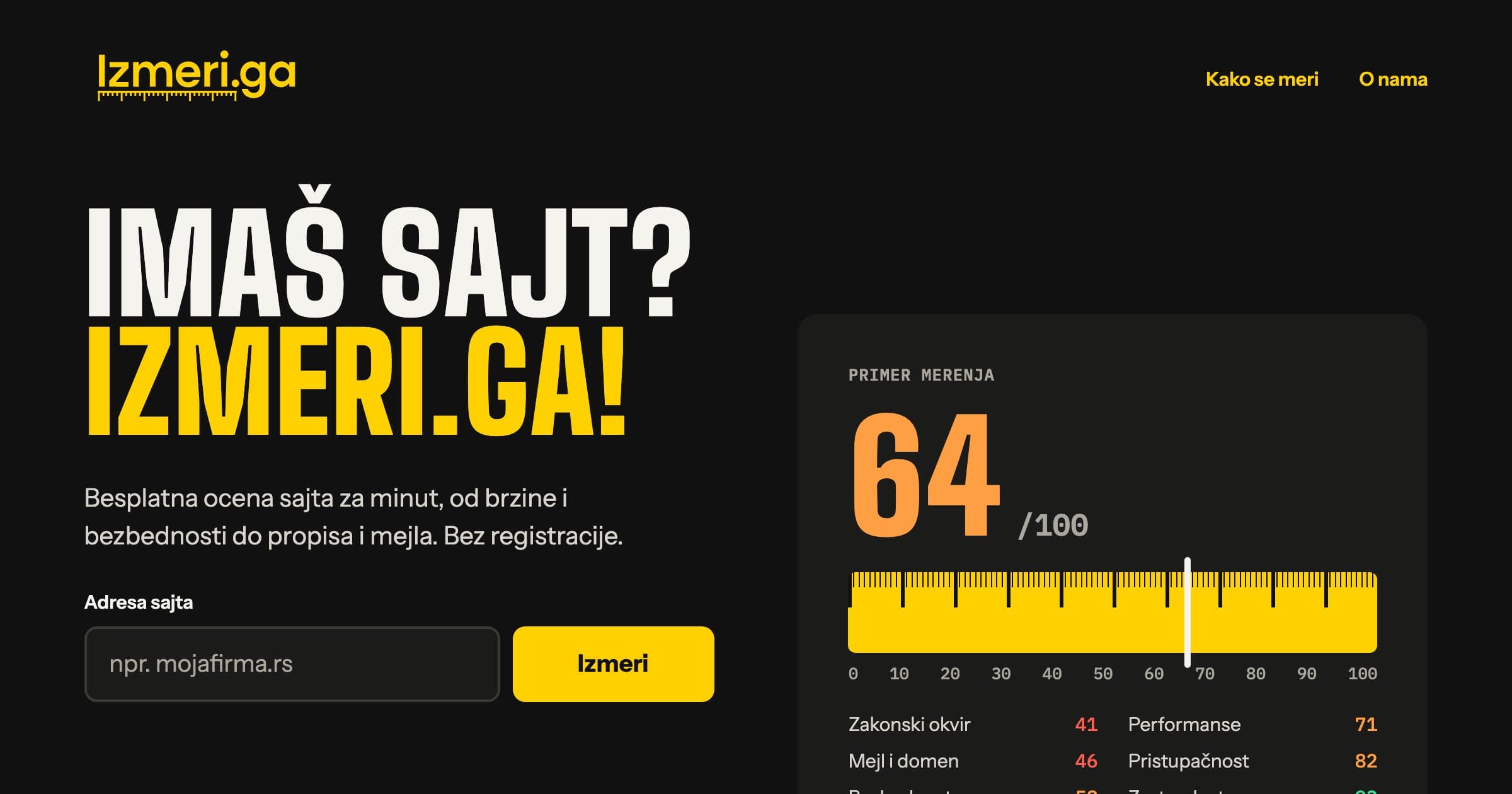
Most small business owners in Serbia have a website and no way to tell whether it is any good. The tools that can tell them are built for developers: a wall of English terms, a score per tool and nothing about the things that get a local business in trouble, such as trackers that fire before a visitor agrees or a domain whose email anyone can forge. Izmeri.ga is my own answer, a small free tool in Serbian. The name is an instruction, "measure it": type in an address and get one number on a ruler, a few findings in plain language and the full report by email. No account and nothing to install.
What I did
A visitor types a site's address and passes a bot check. The scan opens the site in a real browser at desktop and phone widths, runs a speed test at both and an accessibility test and reads what the site sends over the network: its security headers, its cookies and trackers, the software it runs and how its domain and email are set up. That makes 66 checks in eight areas: performance, accessibility, search, the legal frame, upkeep, security, outdated software and email and domain. Each area scores the points it earned over the points it could have, and the eight weighted scores add up to one number out of 100.
The score shows first, before any email is asked for. The full report is sent as a personal link, and the email unlocks more depth, never a different score. Findings are written for an owner and not for a developer: an accessibility result reads as obstacles for visitors who see poorly or use a keyboard. The exact versions of a site's software are shown only when the email's domain matches the scanned site, so the tool does not hand a stranger a list of what to attack. Report pages are kept out of search engines, a scan's results and screenshots are deleted after a set period and daily limits per network and per domain keep the tool from being used as a hammer.
It shares its scan engine with Webokrator, my site builder, where the engine first ran for that product's own customers.
The hard part
A score an owner can trust, from a tool that opens whatever address a stranger types. Two problems sit behind that. The first is honesty. A scan does not always manage to measure everything: a site times out, blocks the browser or hides a file. Scoring the gap as zero punishes a site for my failure and scoring it as full marks flatters it, so anything unmeasured gets half the points and a line that says it could not be measured, and a test in the code fails if any check breaks that rule. The second is safety. A scanner fetches addresses on command, which is exactly what an attacker wants from a server inside someone's network. The launch waited until every connection a scan makes, the browser's included, goes only to the address a guard has judged public, and a set of twelve attack cases passes before any release.
What changed
Izmeri.ga has been live since September 29, 2026, and the first two scans in production finished in 31.7 and 22.7 seconds. Before launch the scoring was run against 34 real sites in three groups: the well-built group averaged 90.8 and the weak group 64.2, with no site below 40, which I keep on record as a known limit of the formula and not a result to hide. An earlier run found that four of five real sites scored zero on the legal area, each for trackers that load before consent, which is the finding owners least expect. How many sites have been scanned is my own figure and is not published here.